Primary directions in astrology, explained plainly
A primary direction is a way of timing events by the turning of the sky in the hours after your birth. As the Earth kept spinning, each planet was carried towards the key points of your birth chart. The distance it had to travel, measured in degrees, is called the arc, and each degree counts as roughly one year of life. So a planet that reached your Ascendant 30 degrees later times an event at around the age of thirty.
It is the oldest timing technique in Western astrology, and the hardest. Ptolemy used it to time the length of life (Augurine, on Tetrabiblos III.10), Morin built his forecasting on it, and most astrologers today never touch it. I use it for every forecast I prepare. On this page I explain it plainly, then show the real arcs from my own published forecast, so you can see how a degree turns into a date and where it can go wrong.
What is a primary direction, in simple terms?
Think of the birth chart as a photograph of the sky at one moment. But the sky did not stop. Within a day it turned a full circle, as it always does. A primary direction asks: after the moment of birth, how far did the sky have to turn before planet A came to the place of point B?
Point B, the one that waits, is the significator. It is usually one of the angles, the Ascendant or the Midheaven, or the Sun or the Moon. Planet A, the one carried towards it, is the promissor, because it brings what it promises. William Lilly put the whole art in one line: to find out "in what space of time the Significator shall meet with his Promittor" (Anthony Louis, on the traditional language of directions).
Morin was particular about the wording. Older authors said the significator is "directed to" the promissor. He pointed out that it is really the moving promissor that comes to the fixed significator (same source). I write directions the way his tables did, for example "Ascendant directed to Sun", but it helps to picture the Sun doing the travelling.
The name "primary" comes from the first motion, the daily turning of the whole sky, the Primum Mobile of the old cosmology (Astrology Weekly dictionary). Because it is the daily turning, the arc is measured along the celestial equator, not along the zodiac.
How does an arc become a date?
By a time key: a rule for how many degrees make a year. There are two in common use.
| Key | Rule | One degree equals | Notes |
|---|---|---|---|
| P | Ptolemy | 1 year | The oldest and simplest. One degree of the equator is one year of life (Kerykeion). |
| N | Naibod | About 1 year 5 days | Uses the Sun's mean daily motion, 0°59'08", as the measure of a year (Astrology Software dictionary). Morin used it (Anthony Louis). |
The difference looks tiny, about five days a degree. But it adds up. By the age of fifty it is the best part of a year.
A worked example from my own forecast
Here is a real direction from the forecast I made for myself and published on the main page. In my chart, the Sun comes to the Ascendant by sextile. The arc is 52.21 degrees. I was born in August 1973.
- Naibod key: 52.21 ÷ 0.9856 = 52.97 years. That falls in late July 2026, and that is the date in my forecast.
- Ptolemy key: 52.21 years. That falls in October 2025.
Same chart, same arc, nine months apart. This is why I always say which key I used. If you read a forecast that gives a direction's date without naming its key, it is fair to ask.
What do all the directions in a real forecast look like?
This is the directions table from the appendix of my forecast, shortened a little to fit. It lists every direction I followed around the year from October 2026.
| Due | Arc | Direction | Kind | Promised |
|---|---|---|---|---|
| May 2025 | 51.05° | Sun to Jupiter, trine | mundane | yes |
| June 2025 | 51.13° | Venus to Jupiter, square | mundane | yes |
| Jan 2026 | 51.71° | Venus to Sun, square | zodiacal | yes |
| July 2026 | 52.21° | Ascendant to Sun, sextile | mundane | yes |
| Aug 2027 | 53.26° | Midheaven to Venus, opposition | zodiacal | no |
| Feb 2028 | 53.77° | Midheaven to Venus, opposition | mundane | no |
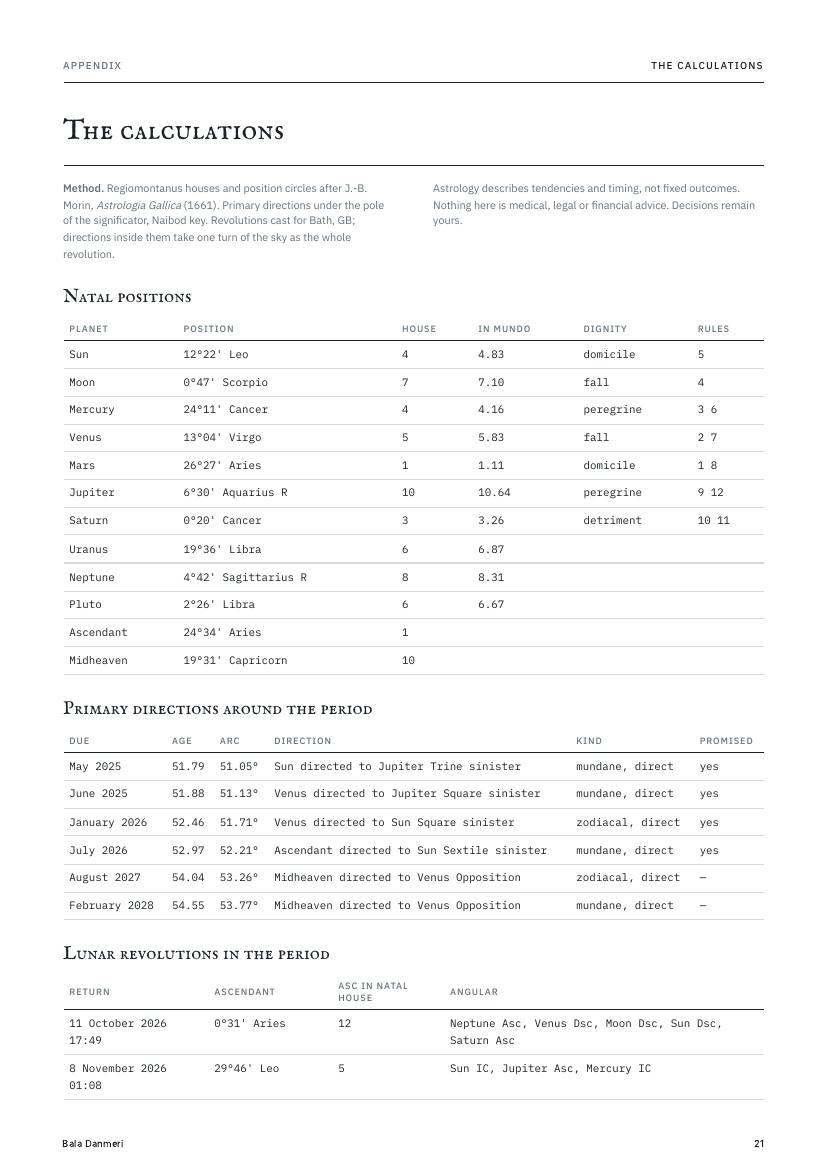
Three things in that table are worth slowing down for. Each one is a question people ask about primary directions.
What is the difference between zodiacal and mundane directions?
Look at the last two rows. The same pair, the Midheaven and Venus, appears twice, six months apart. That is not a mistake. It is the same aspect measured two ways.
A zodiacal direction places the aspect point along the zodiac, where we usually draw planets, and carries that point to the significator. A mundane direction uses the planet's real place in the turning sky, allowing for its distance north or south of the zodiac and for the latitude of birth (Kerykeion). It measures the aspect among the houses rather than along the zodiac.
Both are traditional, and I calculate both. In my forecast I gave this one both dates: August 2027 in the zodiac, February 2028 in the houses. Which of them shows itself, if either, is a question for the solar and lunar returns, not for the direction.
Does every direction bring an event?
No. This is the most important thing I know about directions, and it comes from Morin. A direction can only bring what the birth chart already promises. I explain this rule more fully in Morin's method, in plain words.
The last column of the table is that test. The Sun to the Ascendant is promised, because in my chart the Sun is already the exaltation ruler of the Ascendant. The two are joined before any timing begins. So I gave that direction weight.
The Midheaven to Venus is NOT promised. My birth chart gives no link between them. It looks striking on paper, because Venus rules my money and my partners and the Midheaven is my work. But a direction without a promise behind it is a passing influence, not an event. I said so in the forecast and gave it less weight. I would rather tell a client that than let a dramatic-looking aspect carry a prediction it cannot hold.
Why do primary directions need such an accurate birth time?
Because the sky turns one degree in about four minutes. So an error of four minutes in the birth time moves a direction by about a year (Astrology Weekly; Kerykeion).
My own birth time was never recorded. I worked it out backwards from dated events in my life, a process called rectification. The times that fitted best ran from about 23:02 to 23:12. That is only ten minutes. But for a direction to an angle, ten minutes is two years or more.
So I do not let a direction stand alone. It gives the season, perhaps the year. The solar return, which is far less sensitive to the birth time, then has to repeat it before I trust it, and the lunar returns and transits narrow it further. I only name a window where at least three of these steps agree.
A direction dates a matter to a year, or at best a month. It never gives a day by itself. Anyone offering an exact day from a primary direction alone is promising more than the technique can carry.
How are primary directions different from progressions and transits?
Secondary progressions take each day after birth as a year of life, and follow the planets along the zodiac. A four-minute error in the birth time moves them by only about a day, (Astrology Weekly). I think that forgiveness is a large part of why progressions became the usual choice.
Transits are the planets moving in the sky now. In Morin's way of working they are the last step, the trigger. They release what the directions and returns have prepared. A transit on its own is the weather of the year, not the event.
Primary directions are slower and harder than either. But they were the main timing tool of astrology for well over a thousand years, from Ptolemy to the seventeenth century, and I think they deserve to be used rather than only admired. Morin set out his own approach in Book 22 of the Astrologia Gallica, which James Holden translated into English for the American Federation of Astrologers in 1994 (Goodreads).
Why did primary directions fall out of use?
Mostly the arithmetic. Working out where a planet sits on its position circle, under the pole of the significator, is spherical trigonometry, and by hand it is slow, careful work. I think the birth-time problem also played its part: most people's times are rounded, and directions punish that.
Software has removed the first problem. Free programs such as Primary Direction Explorer will calculate them. The second problem remains, and that is why my own forecast began with the birth time, not the directions. If you are not sure of yours, it is worth knowing that it can often be worked out from a few well-dated events, as I explain on the method page.
Questions people ask
Are primary directions the same as secondary progressions?
No. Primary directions use the daily turning of the whole sky, at roughly one degree for a year of life. Secondary progressions take each day after birth as a year. A four-minute error in the birth time moves a primary direction by about a year, but a progression by only about a day.
Which time key should I use for primary directions?
The two most common are Ptolemy's, one degree for one year, and Naibod's, the Sun's mean daily motion of 0°59'08" for one year. Morin used Naibod, and so do I. Over a lifetime the two can drift apart by many months, so say which key you used.
Can I calculate primary directions myself?
Yes, with software. The arithmetic is spherical trigonometry and was the main reason the technique fell out of use. Several free and commercial programs now calculate them. The harder part is the judgement: whether the birth chart promises the matter, and whether the year confirms it.
Do primary directions use Uranus, Neptune and Pluto?
Not in Morin's method, which was laid down long before they were discovered. I leave them out of the directions, though I show them in the charts.