Morin's method of astrology, in plain words
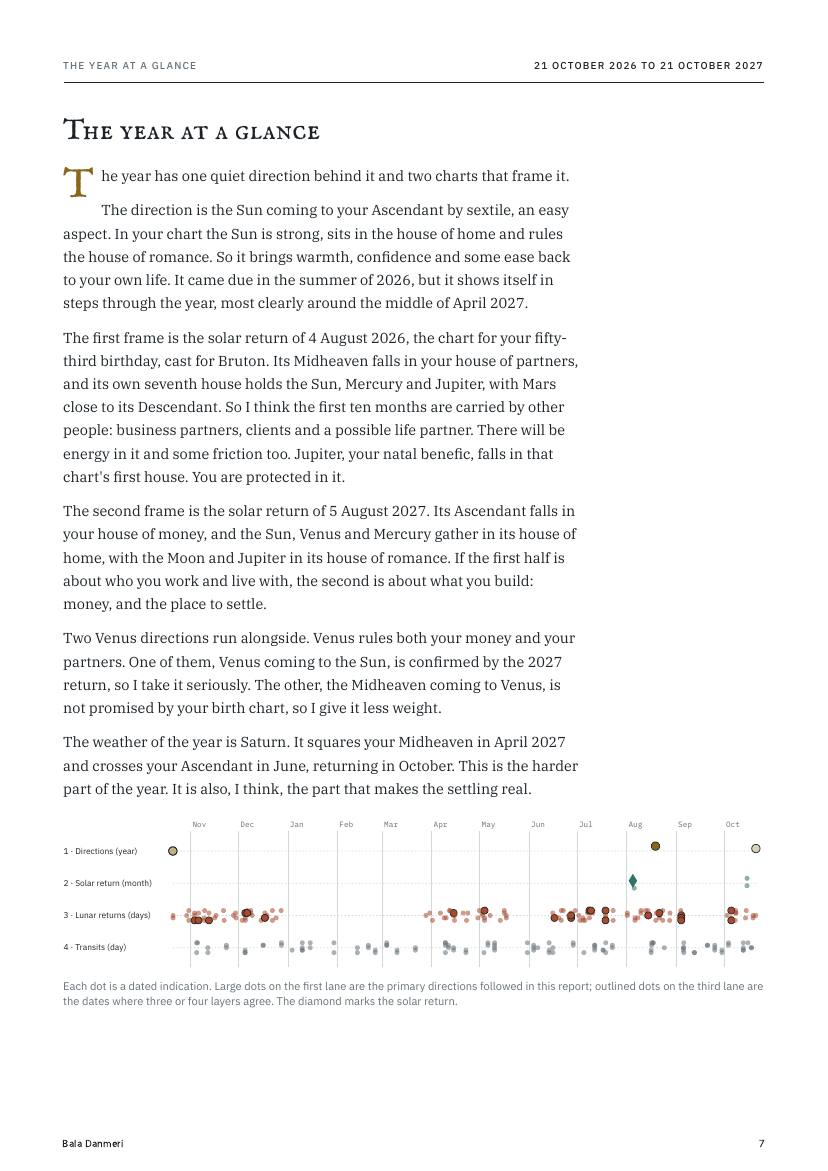
Morin's method is a way of forecasting when things happen, laid down by the French mathematician and physician Jean-Baptiste Morin in his Astrologia Gallica, printed in 1661. It rests on one rule: nothing can happen by any timing technique unless the birth chart already promises it. It then narrows the timing in steps. Primary directions give the year, the solar return gives the month, the lunar returns give a few days, and the transits pick out the day.
That is the whole of it in a paragraph. The rest of this page explains each part, shows what it looks like in a real forecast, and is honest about what it cannot do. I use this method for every forecast I prepare, so I have tried to write the page I would have wanted when I started.
Who was Jean-Baptiste Morin?
Morin was born in Villefranche, near Lyon, in February 1583 and died in Paris in November 1656. He qualified in medicine at Avignon in 1613, and from 1630 until his death he was professor of mathematics at the Collège Royal in Paris (MacTutor, University of St Andrews).
He was not a fringe figure. Cardinal Richelieu set up a commission to examine his proposal for finding longitude at sea, and Cardinal Mazarin later gave him a pension for that work. He also argued, at length and not always kindly, with Galileo and Descartes (Wikipedia).
Astrology was the work he cared about most. He spent decades on it, and his Astrologia Gallica came out at The Hague five years after his death: twenty-six books in Latin, in one folio of around 850 pages. He did not live to see it printed.
What is the one rule at the heart of the method?
The birth chart is the promise. Everything else is timing.
Morin treated the chart drawn for the moment of birth as the full store of what a life can hold. The timing techniques do not add anything to it. They only show when something already in it comes due. So if the chart gives no sign of, say, a business partnership, then no direction, however striking it looks, can produce one (The Astrology Podcast, episode 449).
I think this is the most useful thing in his whole system. It stops the astrologer from reading a dramatic aspect and announcing a dramatic event. The question is always the same: does this chart promise this matter at all? Only then: when?
How does Morin read what a chart promises?
He reads each planet by its place in that particular chart, not by a fixed general meaning. Venus does not simply mean love. It means whatever the houses tied to it mean in your chart: the house it stands in, the houses it rules, and the houses it reaches by aspect. Morin called this a planet's determination (Skyscript, Thomas Callanan).
He then weighs how well the planet is placed by sign, and whether its nature suits the matter. A strong benefic tied to the house of money promises money that comes easily. A weak one promises money that has to be worked for. Not poverty, only effort.
Two other features are worth knowing. He used the Regiomontanus house system and treated the cusps as real boundaries. And he cut away parts of the older tradition that he could not justify from nature, such as terms, faces and most of the Arabic parts, keeping only the Part of Fortune.
How does the method narrow a forecast from a year to a day?
In four steps, each working inside the one before. Morin's main techniques were the directions and the solar and lunar returns, which he called revolutions, with transits used as the final trigger (Wikipedia). This is how I apply them:
| Step | Technique | What it gives | In plain terms |
|---|---|---|---|
| 1 | Primary directions | The year | After you were born the sky kept turning. Each degree of that slow turning carries a planet to a sensitive point of your chart, and each degree counts as roughly a year of life. |
| 2 | Solar return | The month | The chart for the moment the Sun returns to its birth position each year. It shows whether this year will deliver what a direction promises. |
| 3 | Lunar returns | A few days | The same idea for the Moon, which returns about every twenty-seven days. It narrows a month to two or three days. |
| 4 | Transits | The day | The planets moving in the sky that week act as the trigger. |
Primary directions are the oldest and hardest part. They come from Ptolemy and were standard practice in medieval Europe, and Morin set them out in full in Book 22 of the Astrologia Gallica. They are rarely used now, mainly because the arithmetic is demanding (Wikipedia). Book 23 covers the solar and lunar returns. I explain directions step by step, with the real arcs from my own forecast, in primary directions, explained plainly.
Why do I ask three of the four steps to agree?
This is my own working rule, not one of Morin's. I only give a date where at least three of the four steps point to the same matter at the same time. Where they do not, I say so plainly in the report.
I hold to it because any one technique, taken alone, will always produce something. A year of transits is full of aspects. A single direction can be read many ways. But when a direction, the year's solar return and a lunar return all describe the same matter in the same season, that agreement is hard to dismiss. It is also something you can check. Each step is shown with its reasons.
What does this look like in a real forecast?
Before offering forecasts to anyone, I made one for myself, and I have published it in full on the main page. Here is one thread from it, followed through the steps.
The promise
In my chart the Sun is in its own sign, Leo, in the fourth house, the house of home. It rules the fifth house, of romance and children, and it is also a ruler of the Ascendant by exaltation. So the chart promises warmth and strength coming through home and through what I love.
The year: a primary direction
By direction, the Sun comes to my Ascendant by sextile, an easy aspect. It came due in the summer of 2026.
The month: the solar return
The solar return for my birthday in August 2026, cast for Bruton in Somerset, places the year's action with other people, and puts Jupiter, my natal benefic, in its first house. So the year supports the direction rather than working against it.
The days and the day
The lunar returns and transits then point to the middle of April 2027 as the clearest moment for it. That is the window I named. Not the day the thing happens, but the time I would be ready for it.
The whole forecast reads this way: a promise, a direction, a year that confirms it, and a window. You can read all 22 pages and judge the reasoning for yourself.
Why does the birth time matter so much?
Because primary directions move about one degree a year, and the sky turns one degree in about four minutes. So an error of four minutes in the birth time can shift a direction by roughly a year (Wikipedia). A time rounded to the nearest half hour is not enough.
If your time is uncertain, it can often be worked out backwards from a few well-dated events in your life: a marriage, the birth of a child, a move, a change of work. This is called rectification. My own birth time was never recorded, so that is how my forecast began. I worked it out from five dated events before forecasting anything.
A rectified time is a working estimate, not a certainty. I say how much I trust it in each report, and I give windows rather than appointments for exactly this reason.
What can Morin's method not do?
It cannot promise that an event will arrive on time. Astrology is not a proven science, and no honest astrologer can guarantee a date. What the method does well is make its reasons visible. You can see why a window was named and decide for yourself how much weight to give it.
It also does not depend on Uranus, Neptune or Pluto, since Morin worked long before they were discovered. And it should never be used to state frightening things as fact, such as illness or death. I will not do that in a forecast.
Where can you read Morin himself?
Most of the Astrologia Gallica is now in English. James Holden translated most of the astrological books, including Book 22 on directions, published by the American Federation of Astrologers in 1994. Richard Baldwin's 1974 version of Book 21, on interpreting the chart, is a paraphrase rather than a full translation (Skyscript; The Astrology Podcast).
For a spoken introduction, episode 449 of The Astrology Podcast, with Penelope Sitter, the translator of Book 21, is the clearest I know.
Questions people ask
Does Morin's method use Uranus, Neptune and Pluto?
No. Morin died in 1656, long before those planets were found, so his method does not depend on them. I mention them in a forecast only where they add something.
Which house system did Morin use?
Regiomontanus. Morin preferred it, and it is also the frame his primary directions are calculated in.
Is Morin's method the same as Hellenistic or modern astrology?
No. Morin saw himself as a reformer. He dropped a good deal of the older tradition, such as terms, faces and most Arabic parts, and he read each planet by its place in the particular chart rather than by fixed general meanings.
What if I don't know my birth time?
It can often be worked out from a few well-dated events in your life. This is called rectification. It is worth doing before any timing work, because an error of four minutes in the birth time can move a direction by about a year.